Saturday, February 4, 2023

Chesed Begins At "Home"

  I am so proud of Yavneh Academy’s focus on chesed. One particular source of this nachat is our Chesed Team with over 150 members!   Just this week I got two emails from students asking if it was too late to join.  (It is never too late to join the Chesed Team!). And, with pride this past week I read to the 7th graders a thank you note from the Hackensack homeless shelter for the beautiful presentation they performed and the donations of hats, gloves and scarves they organized.   And, not to be outdone, I read the beautiful thank you note I received from the organization Water for South Sudan  to the sixth graders. After reading the book A Long Walk to Water the sixth graders came up with the idea to raise money for water in the Sudan and single-handedly designed a fund-raising plan.  In addition to the mitzvot being fulfilled by the children when they engage with these activities it also has a positive impact on their self-esteem, and reminds them of what is important in life- focusing on others. 


As I spend much of my week planning these activities with the students, I cannot help but think that it is the daily  “chesed” that we put into place in our homes, classrooms, lunchrooms and recess that is just as important as these chesed projects. It is easy and more glamorous to join friends in a chesed project to help those who are obviously in need.  The more difficult job is to show kindness on a daily basis to the child who feels left out during recess, or has no one to work with on a project, or has no invites on Shabbat.  It is harder to show kindness to a substitute teacher who is trying to get the class quiet or the coordinator of the lunchroom who is attempting to get everyone’s attention for benching.  It is more challenging to show chesed at home by cleaning up without being asked, or clearing the table after dinner.  Ironically, we can have children who attend chesed team events, but who struggle in showing chesed to others in their daily lives. 


This past Thursday was my father’s, Rabbi Steven Dworken, HaRav Yisrael Mordechai ben Avraham Dovid,  z”l, 20th yahrzeit. With each year I miss his presence in my life even more. This year we reached out to his rabbinic colleagues to send in Divrei Torah for happy life cycle events which we compiled into a book.  We felt that this was quite fitting as a rabbi he spent many of his days at smachot of his congregants.  But, he did not just attend or officiate at both their smachot and their sad occasions.   As we noted in the dedication of the book:


As children we would often see our father z”l leaving the house on a Sunday with his “Madrich” (his RCA rabbinic handbook) in his hand on the way to join a family at their life cycle event.  Whether a funeral or a wedding our father was not simply going to the event or even to officiate at the event, he was going to join the event with the family. As  Moshe is described  in Shemot 2:11

 וַיֵּצֵ֣א אֶל־אֶחָ֔יו וַיַּ֖רְא בְּסִבְלֹתָ֑ם 

(Moshe) went out to his brothers and looked in their burdens

What does it mean that וַיַּ֖רְא בְּסִבְלֹתָ֑ם he looked in their burdens? Rashi famously answers, based on Shemot Rabbah 1:27

נתן עיניו ולבו להיות מיצר עליהם


He directed his eyes and his heart to be distressed over them.


When Moshe went out to his brother and saw their enslavement and suffering, he did not only sympathize with them, he empathized with them. He actually felt their pain in his own heart.  


As we publish these Divrei Torah  to be used at  Smachot in our father’s memory, we memorialize that when our father was וַיֵּצֵ֣א אֶל־אֶחָ֔יו- he left the house to join his congregants at a simcha - he saw every one of them as his brother.  Then נתן עיניו- he would look, focus  and listen, and  have his congregants confide in him so that he could truly understand what they were going through.   And, then,   וַיַּ֖רְא בְּ - he was able to see clearly what they were going through and actively felt their emotions in his own heart. We would often tease our father that he cried at every wedding, every funeral, every bris, and every bar mitzvah as if they were his own family. 


I believe that is the reason why so many of his colleagues and friends noted that everyone felt as if he was our father’s “best friend.” He had that quality of truly joining with you and caring about you in his heart, (as he said “heart” in his Boston accent).  What was unique about him was that he made great Jewish leaders and Roshei Yeshiva feel that way when he spoke with them, and also teenagers in his shul, as those who contributed to this divrei Torah book attested.  His being involved in a leadership role in the rabbinate did not stop him from caring about each individual.  


And, this connection he made with others was not reserved only for those outside our family.  He practiced the same genuine empathy and care in our own home as well.  From making lunches in the morning  or even running errands for us after we married, our father was as devoted to his family as he was to the Klal. We knew we could always count on him.  His ability to spend endless hours on his communal role and yet spend an equal amount of time if not more time on his familial role was remarkable. He was a model for not only doing chesed for others, but also doing chesed at home as well.  


That is my hope for our students here at Yavneh. That not only should they become experts at chesed for the klal, but more so experts at chesed “at home”- with their classmates, teachers and family members. 


I read an article this weekend called “Can I Polish Your Crown” by Zipora Schuck. She shared that  we are all familiar with the questions that the gemara says will be asked of a person after 120 when he goes up to Shamayim.  “Were you honest in business?”  “Did you set aside a time for learning Torah?”  etc.  But, one not so well-known question, as noted in the book Reishit Chochma, was stated by R’ Yosi who added “המלכת את חברך בנחת רוח” ?  “Did you crown your friend with pleasure (ease of spirit)”?  When we interact with others do we make them feel like kings and raise them up with honor and respect?  Do we compliment others, genuinely listen to them, thinking about their needs before our own, and include those who are feeling sad or left out?  Do we consider whether the way we are about to act might cause pleasure or pain to another?  


This too is chesed. Yes, we do not often think about the chesed we need to implement in our day to day personal interactions.  As the famous saying states “Charity begins at home,” we need to teach our children “chesed begins at home.”  Home is our school, our shul, our camp and of course our families. 


As we celebrate Tu Bishevat this evening may we recall, as it says in Devarim 20:19:

כִּ֤י הָֽאָדָם֙ עֵ֣ץ הַשָּׂדֶ֔ה-  while this phrase is a question in it's original pasuk, many commentaries see it as a statement "Man is like the tree of the field."  Just as a tree needs tending and caring to grow, so too do the people in our lives- through kindness and care. This Tu'Bishvat let us focus on not only the actual trees in our environment, but the people in our daily environment. Are we treating them with care? 


We are having our next official Chesed Team event on February 14th as we prepare for Sharsheret Pink Day on the 15th- a day full of chesed for others. On that day our entire middle school will be engaged in a Hoopathon for Sharsheret.  I am so proud!  But, as I write this article, an idea came to mind. Perhaps at the end of these activities I will ask the students, “Now that we have had the privilege of doing chesed for others, and we are inspired, let us take that spirit and each of us pick one chesed we will do for someone in our homes or school with whom we interact in our daily lives.” After all, chesed begins at home. 


Advisory Update:


Sixth Grade: Students watched real-life scenarios of sixth grade challenges acted by our teachers and discussed how they have been meeting these challenges this year.  They alo set goals for 2nd semester.


Seventh Grade: Students began a new unit called “When Life Gives You Lemons Make Lemonade- Facing Adversity in Life.”  After Rabbi Yitzy Haber shared his life story of facing difficulty with resilience, students discussed why some people are able to be resilient, while others are unable. 


Eighth Grade:  Students discussed cheating in school and some of the pressures students face. 


Sunday, January 8, 2023

This Vacation Disconnect to Connect

  Vacation is coming!  To be honest, I need a vacation…from my phone.  I never feel absolutely relaxed except for on Shabbat, when I cannot check it.  I am constantly responding to e-mails.  And, even if they are not work e-mails, the e-mails are asking for my attention.  On Shabbat I can simply enjoy my children and hopefully they are enjoying their time with me. 

I was recently reading a book by philosophy professor Samuel Lebens A Guide for the Jewish Undecided- A philosopher makes the case for Orthodox Judaism.  He quoted an article by  Rabbi Jonathan Sacks calling Shabbat “the world’s greatest seminar in work-life balance.”  Rabbis Sacks shared a story: A woman from Silicon Valley got in touch with me and said, ‘Rabbi Sacks, I’m worried all our children are addicted to smartphones. They’re ruining their social skills. They’re destroying their attention span.  They can’t concentrate anymore.  So with my children we have decided as a family we’re going to have a screen-free day once a week.  No smartphones, no laptops, no iPads…You’ll love what we are calling it. We’re calling it Shabbat…’  

That is the power of Shabbat today. In Moses’s day, freedom from the slavery to Pharaoh; today, freedom from tyranny to social media and email.” 


(I actually referenced a movement called Tech Shabbat in my blog last year which I had come across when  I saw a link to a video by Tiffany Shalin on Technology Shabbat.  She describes an entire movement, popular even among non-Jews,  to choose one day to disconnect from technology and reconnect with the people in our lives.  It is an opportunity to stop “phubbing,” or snubbing a person in favor of your phone). 


Professor Leben continues that he is not as disciplined as the woman who contacted Rabbi Sacks, and he is constantly tempted and would not be able to keep to a screen free day.  But, “because I relate to it as a commandment from G-d, I find that I am able to keep it up. I am not even tempted…The peace of mind, and the oasis of family time that Shabbat creates, are some serious benefits that accrue to the observant Jew…”


This piece in Leben’s book struck me as I had just read an article in the December 16 issue of The Week magazine “Teens In Crisis- American adolescents are suffering an epidemic of anxiety and depression- why?”  The article begins that even before covid- from 2009-2017, depression spiked 69% among 16-17 year olds (National Survey on Drug Use and Health).  The Center for Disease Control states that high school students feeling “persistent feelings of sadness or hopelessness” has risen from 26% to 44%. Suicide is now the 2nd leading cause of death for children ages 10-14, according to the CDC.  It has been called by the American Academy of Pediatrics a “national emergency.” 


Why? You don’t need to be a research psychologist to take a guess. Smartphones and social media play a significant role! Social psychologist Jonathan Haidt points out that “the crisis emerged in the exact years when American teens were getting smartphones and becoming daily users of social media.”  As I have noted before, teens are constantly comparing themselves to others who seem to have much better and successful lives.  They are feeling more inadequate and left out.  And, of course, spending so much time online they lose face-to-face relationships.  Social media does not give them the social connection they need. And, then there is the lack of sleep due to staying up late on devices, leading to mental health issues. 


(On a side note, just this month alone, I had four conversations with middle school parents who were hesitant to give their children cellphones, but felt they had no choice. I know that many parents are worried about these side effects of device usage). 


So,  both we, the adults, and teens, could use some tech free time to gain some peace of mind.  We need a vacation!


We hope you noticed that we proudly launched our Student Technology Advisory Committee during Chanukah. The 7th and 8th grade representatives will be working throughout the year to come up with initiatives to encourage healthy technology use. The initiatives will come from them.  They began with a “Go Dark While The Candles Are Lit” encouraging students to shut down their phones for at least 18 minutes while the candles are lit to spend time with their families. 


As we take a break from school in the next week, let us all try to take a break from technology- somehow. Whether it is during dinner together. One hour in the car. Or during the boat ride.  Let us take the break we want and need,  and provide our children with the break they may not want, but need as well. 


Advisory Update:

Sixth Grade:Students finished up their unit on manners and proper behavior. They also reviewed what to expect when they receive their first middle school report card, and how to discuss them with their parents. 


Seventh Grade: Students wrapped up their empathy unit with a focus on how we in the Jewish community and at Yavneh apply these empathy skills.


Eighth Grade: Students tackled the tough topic of when in life we might face difficulties and how they can apply resilience skills during this high school admissions process.

Sunday, December 18, 2022

Achieving Happiness Through Chanukah and Chinuch

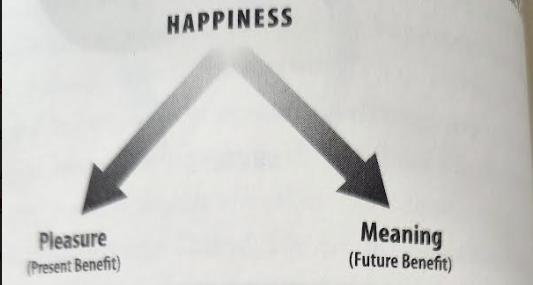
  Recently I reread one of my favorite books, as my daughter was reading it and I decided to reread it with her. Happier written by Dr. Tal Ben Shahar (which I have quoted in my column before), is Ben Shahar’s perspective stemming from scientific research on how to achieve happiness.  His entire book is based on a thesis that happiness is:


In order to achieve happiness one’s actions must hold present  benefit- pleasure and future benefit- meaning.  Happiness= present benefit + future benefit. 


Ben Shahar spends most of the book discussing how we can bring ourselves to happiness in our lives. At one point, he focuses on education.  When it comes to education, says Ben Shahar, it is essential that we not only teach the  Three Rs, but also the fourth “R”- revelry.  “Teachers need to  create the conditions in school that will allow students to revel in learning, in growing, in life itself…Rather than helping students find meaningful and challenging goals and activities, rather than helping students experience the joy of learning, many educators are more concerned with getting students to score well on exams.”  I am proud to say that at Yavneh our teachers are hopefully focused on that joy. 


Ben Shahar then quotes psychologist Csikszentmihalyi who regrets that we as adults often make “serious tasks seem dull and hard, and frivolous ones exciting and easy.”   We need to figure out how to help our students feel joy in all aspects of learning, and not just the “frivolous” ones. 


But, that joy of learning and finding present benefit in learning is not something that is relegated to the schools alone.  We as parents are educators as well. 


Rav Samson Raphael Hirsch notes that the word Chanukah- dedication (commemorating the rededication of the Beit HaMikdash by the Maccabees),  has the same root as the word Chinuch- education- ח.נ.כ. Rabbi Elias Schwartz writes in his book “Veshinantam” quoting the Gerrer rebbe, that when we dedicate a new building or a new home, we are so excited about the fresh start and the new beginning. There is nothing more invigorating than that first day!  


The same needs to be said about Chinuch- education, and by that I specifically mean their Jewish education.  When we educate our children  we need to make sure to show that “first day” excitement.  In every Jewish practice we model for them we need o to incorporate  that excitement as if it was new!   We need to focus on all the meanings of  ח.נ.כ for ourselves as well when educating our kids.  Chinuch is also rededicating the old- renewal.  And, as parents we need to incorporate the excitement of something new into every day when it comes to educating our children about Judaism.  We need make Shabbos exciting, davening exciting and as if it is the first day. When our children see that we have chanukah (a new dedication)  in our chinuch, that is when they internalize what they learn.  


Some years ago, we hosted a Positive Jewish Parenting conference for the community at Yavneh Academy.  Rabbi J.J. Schachter delivered the keynote address on the topic of “The Romance We Pass On To Our Children.”  

Children of all ages must feel romance- a romance that only their parents can show them. Not the romance of love, (which is not particularly applicable for a young child), but rather romance for Judaism, as he quoted from Rabbi J.B. Soloveitchik. Rav Soloveitchik discussed how his father passed on halachic Judaism to him, but his mother passed on the “soul”- the experience- of Judaism. For Judaism is not just halachot and exegesis, but it is a romance. One must become wrapped up with Judaism, as one would with a romantic partner. It is the parent’s job to make sure that happens.

How does one ensure that the Judaism we relay is full of soul? Rabbi Shachter gave one poignant example, based on a footnote of the Rav. The Rav stated how many American Jews are “Shomrei Shabbat,” but very few are “Shomrei Erev Shabbat.” How many of us on Fridays are rushing around preparing for Shabbat and kvetching the whole way how hard it is to get ready for Shabbat? What picture do our children get about Shabbos- that it is a burden. Where is the excitement, “Shabbat is coming!”- the way a real Shomer Erev Shabbat should act. That is why Rabbi Schachter explained that he no longer wishes people “Have a good Shabbat” on Friday. Rather he wishes them to have “Good Erev Shabbat.” And the same goes with shul- the way we schlepp ourselves there clearly does not transmit an excitement for shul and davening. We can model that romance for davening to our children. 

If we do so, our children will find excitement and present benefit (pleasure) in their Shemirat HaMitzvot along with the future benefit  (meaning).  They will thereby achieve through our chinuch that happiness that Dr. Ben Shahar describes. 

Advisory Update:

Sixth Grade: Students focused on appropriate behavior at bar/bat mitzvahs.

Seventh Grade: As part of their unit on empathy, students videoed a performance for the Hackensack Homeless shelter and also focused on the power of kiddush Hashem. 

Eighth Grade:  Students continued with their parent- child relationship unit.

Sunday, December 11, 2022

TikTok or Tick Tock?

  This past summer I was in Monsey shopping. I was standing on line and noticed two children, one I’d say about 6 and one about 3. The 3 year old was kvetchy and getting upset and impatient. The six year old girl turned to him to try to distract him. She said to him “Do you want to hear a TikTok?” I was shocked! First, I was even surprised that this little girl had a phone, never mind TikTok social media!  How could that be?  And, then I see her take her wrist, which was wearing an analog watch (with hands!), and she put it next to the little boy’s ear, and even I could hear the “tick tock” (with a “ck”)  sound coming from the watch.  The boy listened and was soothed.  


This was a true story, and the moment it happened the first thing I said to myself,  “This is going to be for a column!”  The next thing I thought about is how sad it is that most of the children in our lives would never be soothed by listening to the “tick tock” of a watch. In fact, how many of us hand our phones over to our “kvetchy” children to watch videos when we see them losing it while waiting in line?   I remember the good old days when I would sit in the doctor’s waiting room with my children and I would read to them, or we would play a game.  Now, all the children are sitting there on a device-usually their parent’s.  You have heard it all before…children are unable to self-soothe without a device. And, we, the adults, do not even attempt to soothe them without devices. This little girl’s innocent “tick tock” made me feel sad about where we are today. 


This story also made me think about the TikTok that our teens are engaged in today.  One might ask what prompted me to write about TikTok this week when our students have been using it for years?  Recently, we had two bullying situations on TikTok which truly saddened me, and it served as the impetus for me to think about how parents need a reminder about the dangers of TikTok. 


From Common Sense Media: 

Parents need to know that TikTok is a social network for sharing user-generated videos, many of which feature music and sound effects. The app involves a lot of songs, and you can expect swearing and sexual content in some. Though videos viewed during the review process contained only some tight/revealing clothing, depending on which accounts users follow and what content they like, it's possible to encounter sexually suggestive and explicit material.


Here are some of their ratings on the app that truly concern me:


Our teens are exposed to much inappropriate content- through no fault of their own, when using TikTok.  Now, you might say that there is a curated version of the app for under 13. Experts recommend not to use it as the Institute for Family Studies notes that  TikTok offers  a curated version of their app for under-13s. Don’t use it. That watered-down version is designed to fuel interest in the grown-up version. Twelve-year-olds don’t like to be on the kiddie version of anything. And tweens quickly figure out that if they lie about their age, they can easily access the full version. 


I know I may be sharing with you information you might already know, but aside from the inappropriate content there are also the physically dangerous, criminal or even deadly challenges that are rampant on TikTok- like putting metal in a socket causing fires, or the skull breaker challenge causing real harm. And, there are challenges that involve sexually inappropriate behaviors. 


Of the more than a billion users, TikTok is most popular among teens under the age of 16. And, it is addictive like all social media and teens are spending on average 102 minutes per day on TikTok (more than Youtube). 


  And, yes, you might say,  our children are using TikTok positively too- to just enjoy a dance with their friends, to learn new Miami Boys Choir songs (for those who are unaware a 2007 performance of theirs got 8 million views by Jews and non- Jews), and even to learn new things or stand up for what is right by educating others.  


As with anything our children are doing on their devices, we need to be vigilant and monitor their device usage. If you are unsure how to do that effectively, please do contact our technology department who are willing and able to hold your hand to help you learn to do so. (Click HERE FOR A LINK  to a handout Mr. Jason David, our Director of Technology, shared with me about TikTok).    And, of course, discuss the dangers with your children and watch for signs that your child is spending too much time on TikTok and social media in general.


Before I end I want to get back to the discussion of the other Tick Tock.  While most of our students no longer know how to tell time on an analog clock and ask to use only digital, I still maintain the importance of teaching children to tell time on an old-fashioned clock. Primarily, it is easier to visualize time on an analog clock. What does twenty minutes to 2:00 mean?  It helps them understand the passage of time better. 


This week in our Homeroom Organizational Skills classes with our sixth graders we discussed the “time bandit” who often steals our time. “The Time Bandit gets into the parts of your brain that keep track of time. It confuses you, so you lose track of how much time you have left before you need to do something or how much time has passed while you’re working. These tricks often get you into trouble; you might end up being late to school and have trouble fitting in the work you have to do each evening.” One item that stands in their way is their inability to predict how long something will take them to do.  Their sense of time is off. We will be working on that in class, but believe it or not, an understanding of time does come along with that analog clock usage. 


(Interesting to note,  the students unanimously agreed something that “steals” their time is their technology usage. Before they know it, they are on TikTok or Youtube for hours). 


It says in Avot 2:15, 


רַבִּי טַרְפוֹן אוֹמֵר, הַיּוֹם קָצָר וְהַמְּלָאכָה מְרֻבָּה,

Rabbi Tarfon said: the day is short, and the work is plentiful


When students have no sense of time, the day is always too short and the work is always too plentiful.  When they have a better sense of time, their day is long enough and the work is manageable. 


As middle school parents we need to try to help our children manage both the TikToks  and the tick tocks in their lives.  


Advisory Update:

Sixth Grade: Students had the chance to “switch places” with their teachers and understand the teachers’ perspectives. 

Seventh Grade:  Students learned the skills of empathy

Eighth Grade: Students began a unit on the parent- child relationship.

Tuesday, November 22, 2022

Hallel on Thanksgiving?

        This year Thanksgiving is also Rosh Chodesh.  (Those who need not wake up earlier for the longer Rosh Chodesh davening due to the day off have an additional  reason to be thankful  this Thursday!) 


The co-occurrence of Rosh Chodesh and Thanksgiving led me to consider what those two holidays have in common,  and what we can learn from their falling out on the same day this year.  (Not as exciting as a Thanksgivukkah, I know, but still something to note). 


 Rosh Chodesh is a day of reciting Hallel. If one looks through Hallel one can see that it is replete with the giving of thanks to Hashem.  Here is just a small sampling (Note:  Hallel is a mix of praise and thanks, and praise is clearly a form of thanks even when it does not include the word “thanks”). 

פִּתְחוּ לִי שַׁעֲרֵי צֶדֶק. אָבֹא בָם אוֹדֶה קהּ

. Open up for me the gates of righteousness; I will enter them, thank the Lord

אוֹדְךָ כִּי עֲנִיתָנִי. וַתְּהִי לִי לִישׁוּעָה

I will thank You, since You answered me and You have become my salvation

הוֹדוּ לַה' כִּי טוֹב. כִּי לְעוֹלָם חַסְדּוֹ

Thank the Lord, since He is good, since His kindness is forever

כִּי לְךָ טוֹב לְהוֹדוֹת. וּלְשִׁמְךָ נָּאֶה לְזַמֵּר

Since, You it is good to thank, and to Your name it is pleasant to sing


So, in essence Rosh Chodesh- a day of Hallel, and Thanksgiving have similar themes- that of thanks. 


 I recently came across an article which states that Congregation Shearith Israel in New York does say Hallel on Thanksgiving- even when it is not Rosh Chodesh. (I am not paskening halacha here, but sharing their shul’s practice).    Shearith Israel was established in 1654, also known as the Spanish Portuguese Synagogue, in what was then New Amsterdam by a group escaping the Portuguese inquisition, and was the first shul established in North America.  


In 2013, when Thanksgiving fell out during Chanukah, Rabbi Meir Soloveichik, the rabbi of  Shearith Israel, wrote an article in the Wall Street Journal  “God Delivered the Pilgrims- and My People.”  In this article Rabbi Soloveichik notes that in 1789 the first national Thanksgiving was proclaimed by the President. At that time,  the leader of the shul, Gershom Mendes Seixas, proclaimed that in gratitude to the freedom they were granted in America, their shul will be reciting Hallel every Thanksgiving. 

 These were his words:

 "As Jews, we are even more than others called upon to return thanks to God for placing us in such a country—where we are free to act according to the dictates of conscience, and where no exception is taken from following the principles of our religion.”

In Mendes- Seixas’ words he states that  the thanks expressed on Thanksgiving should be turned to God.  

Rabbi Jonathan Sacks, ztl,  in his article “The Power of Gratitude” notes that a significant component of having true gratitude/ thankfulness is that recognition of God in our lives.Part of the essence of gratitude is that it recognizes that we are not the sole authors of what is good in our lives… Though you don’t have to be religious to be grateful, there is something about belief in God as creator of the universe, shaper of history and author of the laws of life that directs and facilitates our gratitude. It is hard to feel grateful to a universe that came into existence for no reason and is blind to us and our fate. It is precisely our faith in a personal God that gives force and focus to our thanks.”

And, that is why, says Rabbi Sacks, that it is no coincidence that Thanksgiving was established as a day  “recognizing the presence of God in American history.”  He then goes on to quote the words of Abraham Lincoln on Thanksgiving of 1863:


No human counsel hath devised nor hath any mortal hand worked out these great things. They are the gracious gifts of the Most High God, who, while dealing with us in anger for our sins, hath nevertheless remembered mercy … I do therefore invite my fellow citizens in every part of the United States … to set apart and observe the last Thursday of November next, as a day of Thanksgiving and Praise to our beneficent Father who dwelleth in the Heavens.


So, in its early years, Thanksgiving was established as a day of gratitude to Hashem! 


I have mentioned many times in this column the research-based data on the positive impact of gratitude on both psychological and physical health.  Being thankful leads to more resilience in face of stress, happiness, hope, less depression and even longer and healthier lives.  So, we clearly want to all practice that gratitude- we all want those benefits!  


Combining gratitude of Thanksgiving with the gratitude to Hashem, of the Hallel is one way to make that happen. 


Christopher Kaczor in his Washington Post article “Does belief in God enhance gratitude? Here’s what psychology suggests” quotes Dr. Robert Emmons from his book Thanks! How Practicing Gratitude Can Make You Happier.   Dr. Emmons notes that gratitude that leads to happiness must have three components that are recognized by the one who is thankful:

 “ 1. That one has been the beneficiary of someone’s kindness 2. That the benefactor has intentionally provided a benefit 3. That the benefit has value in the eyes of the beneficiary.” 

It consequently makes sense that  the research indicates that those who believe in God and realize that their lives are not mere chance (intentional) , but are a result of God’s care (beneficiary of His kindness) and see that all that happens to them as a gift of God (benefit has value), would be happier.   It, therefore, does make sense that belief in God is one predictor of happiness.


In being thankful this Thanksgiving the opportunity to say Hallel reminds us that being thankful to Hashem is an important component of achieving true gratitude. But, we need not wait until a random year where Thanksgiving and Hallel coincide. We are reminded of this daily, as Rabbi Sacks says, “Jewish prayer is an ongoing seminar in gratitude.” He notes starting from Modeh Ani in the morning, our daily prayers- whether birchot hashachar, pesukei d’zimrah or even the Shemoneh Esrei “form a litany of thanksgiving for life itself.” We need not wait for that Hallel on Rosh Chodesh. 


Dr. Tal Ben Shahar (whom I have quoted many times before!) was a professor at Harvard famous for his course on  Happiness based on scientific research and practical strategies to achieve happiness. In his book Happier Dr. Ben Shahar promotes keeping a gratitude journal and writing down five things each day before you go to bed to lead to happiness. (This is actually an assignment he gave to his students in Harvard as part of their classwork).  We cannot wait for Thanksgiving to work on our gratitude.  If we put this into practice with our own children at home, perhaps we would add, what are we thankful to Hashem for in our daily lives? 


On this Thanksgiving as Rosh Chodesh Hallel is recited, let us focus with our children on all they have to be thankful for, and remember to point out to them Hashem’s role in bringing all those positives to our lives. 


Advisory Update:

Sixth Grade:  Students had an opportunity to “switch places” with their teachers in imagining what it is like to be a teacher in order to understand the teacher-student relationship better.


Seventh Grade: Students focused either on a lesson on anger management or began the next unit in Advisory - Operation Respect, on empathy.  


Eighth Grade: Students did a unit on Test-taking strategies. 


Sunday, November 13, 2022

Hosting An Open House In Your Home

  We at Yavneh Academy recently hosted our Open House for prospective parents where we proudly showcased all that we deem to be dear to us at Yavneh. For those of us who have 8th graders, we have spent much of the past weeks attending open houses where the local high schools were able to showcase their accomplishments as well.  


Putting together an open house is quite a lot of work, and is most definitely an event a host school does not want to do more than once a year.  But, there are two components of the open house that I believe are necessary and integral for every school’s success and the open house forces us to engage in those two endeavors.


  1. The open house forces us to assess- what are our values? What does our school stand for?  What is important to us? What do we want to ensure our children leave these walls knowing and inculcating into their lives? 


  1.  The open house forces us to evaluate our progress. We uncover  areas in which we have improved (which we clearly showcase!). A by-product of that evaluation  is our ability to uncover areas in which we still need some improvement.  We thereby have the opportunity to rejoice in our achievements, which is so essential for school morale and for continuing that growth. But, we also have time to introspect and think about what we want to improve on so that by next year’s open house we can report that at Yavneh this is an area of pride.   On one hand we need to recognize our growth, while on the other hand, humbly working on self-improvement. 


Another by-product of the open house is creating an “open house”- stressing that EVERYONE has a place here at Yavneh. We teach so many different types of students and families and welcome all in. 


Open house season fits in perfectly with Parshat Vayeira as we know that Avraham had a tent with four doors- open to all. Everyone was invited into Avraham’s home- all types of visitors.  And, what type of open house did Avraham showcase? One of chesed. 


So, we at our schools showcase our values at our open houses, as did Avraham. And, also brings to us a yearly “self-evaluation” where we consider where we want to improve. 


 This brought me to thinking. What if we had to have an “open house” at our homes. Not the kind that a real estate agent runs to sell our homes- not that kind of open house- but what if we had to showcase our values, what we are proud of and what our family stands for, just like a school does?  What would the Frohlich Family open house look like? What are our values? 


For whom is this open house being held? For our own children, of course. We aren’t trying to recruit new people into our family, but we are trying to recruit our children into living our family values.  


How? The Center for Parenting Education highlights some techniques on their website:.  1. Moralizing.  This is more often used when kids  are younger and we very directly tell them what our values are through teaching. Long preachy lectures are not helpful. It is better to do direct teaching in small spurts.  “I expect you to tell the truth.”  “When I go out of my way to study with you each day, I expect you to say thank you.”  It is important not to overdo moralizing, as as children get older they will tune out if we go on and on.  But, moralizing is still important. 


2. Modeling- the parent acts with that value in front of the child. When you leave a supermarket and you realize that there is an item you neglected to pay for and you turn around to go back in to pay and you say to your child “It would be stealing if I took it without paying” you are thereby modeling a value.  Children are influenced by the values they see their parents acting upon. 


I do believe it is key to discuss the value after you have modeled it so they get the point. 


And, of course, if we tell them to live by a certain value, but we ourselves do not act that way, “do as I say not as I do” that value will never be inculcated. 


3. Teachable moments- this is a third technique that I often stress.  Find those opportunities- whether after watching a movie, hearing a story with a peer or even witnessing something firsthand to clarify why that is or is not our values, and what our values are.  “Why do you think what that person did was wrong or right?” “What would you have done?”  When we see our children behaving in a way that represents a value, then label it. “I see you were willing to share your time on the computer with your brother and you were generous.” 


By telling our children what we value, modeling it, finding those teachable moments to discuss we relay our values.   But, of course, just like Yavneh did in our open house, first you have to identify what your values are and what you want to relay to your children- along with your spouse. 


  For those who have been reading my column for some time, you will recognize that this is my opportunity to bring up my favorite Gemara regarding Yoseph, Yaakov and parenting. When Yoseph was in the house of Potiphar, far from home and his family, he faced the difficult situation of the wife of Potiphar. The Gemara in Sotah 36b describes, “It was taught in the School of R. Ishmael: That day was their feast-day, and they had all gone to their idolatrous temple; but she had pretended to be ill because she thought, I shall not have an opportunity like to-day for Joseph to associate with me. And she caught him by his garment, saying etc. At that moment his father's image came and appeared to him through the window and said: 'Joseph, your brothers will have their names inscribed upon the stones of the ephod and yours amongst theirs; is it your wish to have your name expunged from amongst theirs and be called an associate of harlots?' Immediately his bow abode in strength.”


Clearly Yoseph's father was far away in Canaan- how could he have seen the image of his father Yaakov in the window? That image of Yaakov that he saw was the voice in his head. Over and over he had heard his father say, “Good boys don't act that way. In our family, our values are...” And, of course, like any teenager, (Yoseph was just 17 when he went to Egypt), he said to his dad, “I know, I know- why do you keep on telling me the same thing?!” And, yet, Yaakov continued sending those messages. That is why, when faced with a challenge to his morality, he heard that voice in his head.


So, some of you might have been reading this article and saying to yourself that when we have our frequent “talks” with our children they say to us, “I know, I know- enough already!” And, yet when they are faced with challenges, whether peer pressure to do the wrong thing or the temptation to engage in any at-risk behavior, or even the temptation to skip their homework, they will hear our voices in their head, and practically see our images before them reminding them of what they should do. At the end of the day, if we do a good job at relaying our values, they will remember them and act upon them. 


As we are all planning our family open houses- considering what values we want to relay and what our family stands for, we cannot forget that  during the planning stages of this open house we also have to do just what we at Yavneh do each year- in what areas has our family improved? In what areas do we still need to grow?  Good luck planning your open house…and don’t forget the swag! 


Advisory Update:

Sixth Grade:  Students discussed appropriate behavior and manners as students in a classroom. 


Seventh Grade: Students debriefed their Frost Valley trip and considered what they gained.  They also had the opportunity to practice their listening skills


Eighth Grade: Students discussed the importance of “goodness.”