Sunday, February 18, 2024

Super Bowl and Life Lessons For Our Teens- 2024

  Yes, it is my traditional post-Super Bowl column.  (A reminder to those who haven’t read my column before this year, I have been writing lessons to learn from the Super Bowl for some years now the Sunday after the event. Full disclosure- I don’t watch the Super Bowl, but do try to nose around for lessons that can be gleaned).  

First, a thank you to the parents who helped their children be sensitive when it comes to making sure their Super Bowl get-togethers were not hurtful to others, including not posting photos of get-togethers. Thank you! 

This  year, I wanted to focus on a small thing that happened at the game that related to a conversation I had with some students in school this past week.  Teresa Hammond, in her “Mommy Musings” wrote about “Lessons And A Loss.”   She writes about a bit of time in the game to which many probably did not pay attention: 


Personally I know little about Travis Kelce. Google informed me he’s a premium tight end, makes $14 million a season and he was drafted by the Chiefs in 2013. Now he’s the main squeeze of Taylor Swift and football fans, as well as parents across the country, seem to have a lot to say about that…

As a parent and an athlete I was (and still am) appalled. For those who missed it, it came following a fumble by the Chief’s Isiah Pacheco, as Kelce watched from the sidelines. Clearly frustrated and feeling he could’ve done better, Kelce got in the face of longtime Chiefs Coach Andy Reid, as well as attempted to grab him by the arm.

A true seasoned professional, Reid blew him off and eventually Kelce was returned to the field. Brat move, in my humble opinion. One which should have placed him on the bench for the remainder of the game.

Reading on this topic the following morning, I have yet to find a piece written defending Kelce’s behavior. That’s refreshing. There are however numerous articles with speculation: had Reid benched him, he’d have lost his job; a fine would do nothing; refs wouldn’t eject a player for behavior of this nature and of course the had he been a B player versus who he is, this story would have played out drastically different.

Professional athletes, just like celebrities, like it or not are role models. Yes, I understand they too are human, yet they’re humans with many eyes (especially young ones) watching. Challenging a coach in such a manner, I don’t care who you are, is classless and disrespectful. That’s what young eyes saw on Sunday. One of the best in the game was so bold and full of himself that he challenged his coach during live play with no repercussions…

A game I will not soon forget, an outcome I’m still a bit confused by and a player who is at the center of the world’s attention professionally and personally who rather than publicly apologizing for his ill behavior blew it off post-game with, “Oh you saw that? I was just telling him I love him.” 

     So, while I have no idea if Travis Kelce is popular because of his skill or because he is dating Taylor Swift, (I imagine both), what a poor role model for our children watching the Super Bowl. 


Interestingly enough, during this past January break I went to my first live professional hockey game. I have been to hockey games in the yeshiva league, but other than that never. I was shocked to see the players fighting with each other on the ice. I know for those of you who are hockey fans that’s normal behavior, but I had never seen anything like it.  (In my research, I did uncover that there are actually rules in regards to this fighting). Predictably, I turned to my kids and my husband and said, “What poor role models for the children in the audience!”   We try to teach our children about sportsmanship, controlling one’s emotions and respect,  and these players are showing our kids exactly what not to do! And, it’s supported by the rules! 


Where is the sportsmanship we are constantly trying to teach our students.  Dr. Margaux Barnes writes in her article “How To Be A Good Sport” that sportsmanship is:

  • Follow the rules of the game. Accept calls and don't argue with officials.

  • Have a positive attitude and give your best effort.

  • Support your teammates by saying something like, "Good shot" or "Good try." Don’t criticize them if they make a mistake. You wouldn’t want someone blaming you if you miss a shot.

  • Treat the other team with respect and don’t tease or bully. Shake hands before and after the game. Help players up if they fall — even if they’re not on your team.

  • Take pride in giving your best at each practice and game. Winning is fun but don't rub it in. If you lose, accept the loss without getting upset or blaming others.

Luckily, here at Yavneh our coaches are wonderful role models when it comes to playing fair and respecting others. There is no way that such behavior in the Super Bowl or in the hockey games would be tolerated in a game, recess or physical education class.  (Just to add a shout-out to our physical education team, I have had conversations with every single one of them this year about concerns they have about their students not only being players, but also demonstrating true concern about each and every one of their students).  I do worry at times that during recess, when our students have oversight, but not coaching, they do at times have difficulties being “sportsmanlike.”  We continue to reinforce that being kind is always more important than winning. 

I recently came across an article written by someone named Nicholas Doorlay “How To Be Kind and Competitive” as he writes about becoming a “kindness certified sports’ team.” 

To a lot of athletes, kindness is uncool. This is a problem that not only manifests itself in the macho attitudes and atmospheres of high school sports such as football and basketball, but is also reflected in the fights and bouts we see during NBA, NFL, NHL, and MLB games. Tempers flare, and athletes are competitive people by nature. They’re just out there trying to win; you can’t blame them. It’s as simple as that…When you are in an atmosphere where kindness becomes the norm, you realize that it is indeed possible to be competitive and kind at the same time. For example, at my last track meet, we had 26 high jumpers vying for the top seven spots in order to move on to our section finals. Yet, every athlete out there was 100 percent supportive of the others and cheering everyone on. I was getting tips and pointers from the athletes whom I was competing with, and trying to beat.”  Our children look up to us when it comes to these behaviors and whatever we can do to reinforce kindness on the field is essential. 

I want to add that this "kindness" in sports is not limited to how athletes treat their teammates or their coaches. It also translates to how they treat the students who aren't on the team who may not be as athletic as they are. This past week, in our Sharsheret Pink Day Hoopathon, everyone gets to shoot hoops. One need not be athletic. It was wonderful to see how some of our stars on our teams made sure to not "show off" and to allow each person to have his/her moment to shoot. Those of us who are parents of athletes need to remind our children to be inclusive during recess and gym class, and not only throw to or choose the kids on the team.

This past Friday, our 8th graders were addressed by the YU Maccabees and the Lady Macs basketball teams. One primary theme of the Lady Macs was the importance of making a kiddush Hashem in the way you treat all the members of the other team and how you demonstrate sportsmanship. 

These instances of losing one's cool I described above reminded me of a conversation I had with some students about a situation in class. A teacher asked a student to stop engaging in a particular behavior. The student felt he was not doing that behavior.  He then went on to argue with the teacher in front of the class that he did not do that behavior. I am the first one to want to ensure that a child is not accused of something he/she is not doing. But, what I explained to the students is that answering back and arguing with the teacher will just make things worse. The best bet is to speak to the teacher after class and politely explain that perhaps the teacher misunderstood or “mis-saw” what you were doing. It takes real maturity for a child to hold himself back in a respectful manner, even if he disagrees, and then discuss it maturely after. Teachers truly admire that.   It requires self-restraint and containing one’s emotions- something that Travis Kelce and the hockey players I saw could not do. 


What I wanted to make clear to the students, that it is okay to respectfully disagree. In fact, as Rabbi Jonathan Sacks writes in his article “God Loves Those Who Argue”  that Judaism is actually very supportive of disagreement and arguing. Avraham and Moshe “disagreed” (respectfully) with Hashem Himself! 

Judaism supports arguments where “ it is one in which you give a respectful hearing to views opposed to your own, knowing that your views too will be listened to respectfully…Equally striking is the fact that the Sages continued the tradition and gave it a name: argument for the sake of heaven,[7] defined as debate for the sake of truth as opposed to victory.[8] The result is that Judaism is, perhaps uniquely, a civilisation all of whose canonical texts are anthologies of arguments. Midrash operates on the principle that there are “seventy faces” to Torah and thus that every verse is open to multiple interpretations. The Mishnah is full of paragraphs of the form, “Rabbi X says this while Rabbi Y says that.” The Talmud says in the name of God himself, about the conflicting views of the schools of Hillel and Shammai, that “These and those are the words of the living God.”[9]

A standard edition of Mikraot Gedolot consists of the biblical text surrounded by multiple commentaries and even commentaries on the commentaries. The standard edition of the Babylonian Talmud has the text surrounded by the often conflicting views of Rashi and the Tosafists. Moses Maimonides, writing his masterpiece of Jewish law, the Mishneh Torah, took the almost unprecedented step of presenting only the halakhic conclusion without the accompanying arguments. The ironic but predictable result was that the Mishneh Torah was eventually surrounded by an endless array of commentaries and arguments. In Judaism there is something holy about argument.

  But, the story of Korach is an example of when argument is not for the sake of Heaven, but just to achieve victory.  

“What the entire episode shows is the destructive nature of argument not for the sake of Heaven — that is, argument for the sake of victory. In such a conflict, what is at stake is not truth but power, and the result is that both sides suffer. If you win, I lose. But if I win, I also lose, because in diminishing you, I diminish myself… Argument for the sake of power is a lose-lose scenario. The opposite is the case when the argument is for the sake of truth. If I win, I win. But if I lose I also win — because being defeated by the truth is the only form of defeat that is also a victory.”

We want our students to have good sportsmanship on and off the field- in class, in their homes when they disagree with their parents, and on and off-line with their friends. Control your emotions, be respectful and if you can’t, take a break and come back later to discuss when you can be. 

I guess it’s too bad that Travis Kelce and the pro- hockey players I saw weren’t students at Yavneh Academy. Then they would have perhaps learned in their academic classes, Advisory classes and in their physical education classes how to be good sports. 


Advisory Update:

Sixth Grade: Students began a unit on Friendship- what qualities do we look for in a friend?

Seventh Grade:  Students learned more about the myths regarding Israel that are being spread and how to combat those myths. 

Eighth Grade: Post- Super Bowl students discussed ethics in sports. 


Sunday, February 11, 2024

The Pursuit of Happiness

  This past week I had the privilege to be a part of the Yachad Yavneh Shabbaton. What a wonderful experience for both our Yavneh students and the Yachad members (and the Yavneh faculty!)  Additionally, I had the opportunity to give a shiur to the women of the Shomrei Torah community as part of the Rosh Chodesh women’s shiurim series. I was thankful to be asked and it was so nice to see the amount of people who came. 

As we were about to embark on the month of Adar I what better topic than “The Pursuit of Happiness” as we know it says in  Gemara Taanit 29a  מִשֶּׁנִּכְנַס אֲדָר מַרְבִּין בְּשִׂמְחָה  “When the month of Adar begins, one increases rejoicing.”  And, this year we have two Adars- double the happiness! 


The topic of happiness is one that I have discussed in my column before, and when writing of this topic previously I have ALWAYS quoted different pieces of the writing of Dr. Tal Ben Shahar.  Dr. Tal Ben Shahar is the author of the books, Happier, Being Happy and The Pursuit of Perfect.  Dr. Ben Shahar was a professor at Harvard famous for his standing room only course on Happiness based on scientific research and practical strategies to achieve happiness. (He has since returned to Israel).  


Lo and behold, as I was preparing for my shiur, which of course would include some of Ben Shahar’s research, I came across an email in my inbox that Congregation Rinat Yisrael was hosting a book launch of the book An Ode to Joy- Judaism and Happiness in the Thought of Rabbi Lord Jonathan Sacks and Beyond, a book of essays coedited by Erica Brown and Shira Weiss. My first thought was, of course, why couldn’t I have had this book before I prepared my shiur?!  Oh well!  I then continued reading and saw that the guest speaker would be Dr. Tal Ben Shahar who wrote the forward to the book!!! (For those of you who have been reading my column for some years, you know exactly why I put in so many exclamation points. I am definitely a fan). And, then, I thought again, why couldn’t I have given the shiur after hearing Dr. Ben Shahar in person and getting the book?! 


Ben Shahar began his presentation by discussing what true leadership is. It is not charisma or eloquence.   In fact we know that Hashem chose Moshe who was כבד פה וכבד לשון-  heavy of mouth and heavy of tongue, with some sort of speech impediment. Because, said Ben Shahar, the most important part of being a leader is not the ability to speak, but the ability to listen.  In thinking about the Yachad Shabbaton I realized that the leadership our students demonstrated at the Shabbaton involved their ability to listen to the Yachad members, and to cheer Yachad members on when they were in the circle. Our students’ leadership was not about the attention they received. It was about focusing their attention on others. 


He continued to base the rest of his presentation on the 5 aspects of Happiness according to his research. (I will only focus on one today- more material for future columns!) 

a. Spiritual well-being b. Physical well-being c. Intellectual well-being d. Relational well-being e. Emotional well-being. 


His points regarding relational well-being fit in perfectly with the Shabbat I had just experienced.  Relational well-being is the number one predictor of happiness.  But, it is not simply hanging out with friends.  Both in the introduction to the book and in his presentation that night, Ben Shahar spoke of the Hebrew word נ.ת.נ- to give. It is an unusual word as it is a palindrome- it can be read left to right or right to left.  He quoted research by Ed O’Brien and Sonja Lyubormirsky on happiness which noted that one of the “most powerful ways to increase our own happiness is through giving, because when we give we are given right back.”  And, then he quoted Rabbi Sacks “The best way of encountering G-d is to give.  The very act of giving flows from, or leads to, the understanding that what we give is part of what we were given…Happiness is not made by what we own. It is what we share.” 


And, he added that when we awaken in the morning we say מודה אני not אני מודה- notice the first word is not “I.”  Happiness is not about our own pleasure. Happiness is about giving to others. 


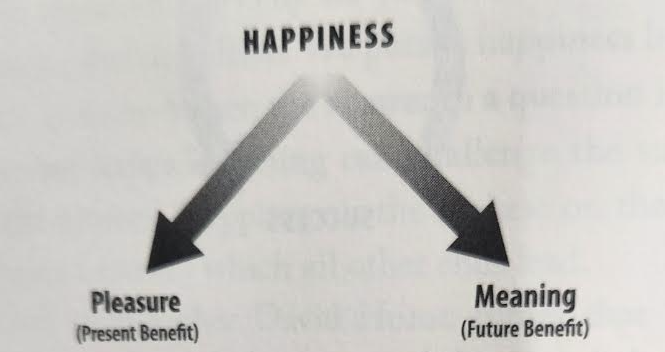
As I had shared in the shiur that Shabbat, Dr. Ben Shahar’s thesis on happiness can be summarized into: 


In order to achieve happiness one’s actions must hold present  benefit- pleasure and future benefit- meaning.  Happiness= present benefit + future benefit. 


In his book Happier he speaks about the “hedonism archetype.”  “A hedonist seeks pleasure and avoids pain. She goes about satisfying her desires, giving little or not thought to future consequences. A fulfilling life, she believes, is reducible to a succession of pleasurable experiences. That something feels good in the moment is sufficient justification for doing it until the next desire replaces it. “ Whereas, a person experiencing true happiness needs to feel as if his/her actions has an effect on the world.  To be clear, as you see above, one’s efforts to live a life of meaning, but also have some “present benefit”= pleasure. But, just pleasure without meaning will never lead to happiness. 


And, thus, the topic of my shiur was the “pursuit of happiness” words from our Declaration of Independence. Note that it does not say “ pursuit of life, pursuit of liberty and pursuit of happiness.” It only says “pursuit” in relation to happiness. While I am not an American history expert, to me it seems that achieving happiness is hard work, and one must actively pursue it. (Ben Shahar spends much time in his book discussing that “here on earth we need to work to be happy.”) 


So, in essence the timing was perfect.  As I sat and listened to Dr. Ben Shahar’s presentation, which connected some of his research to the words of Rabbi Sacks, I was reminded of why these Yachad Shabbatons are so important, and why in the next week alone I am busily planning Sharsheret Pink Day, and our next Chesed Team event.  What does the guidance counselor have to do with Chesed projects in the school? Ah...isn’t it obvious? Events like Sharsheret Pink Day, chesed team events and Yachad Shabbatons provide the meaning that our children need along with the pleasure.  That is why, if your child is a member of the Chesed Team, I always write,  “Looking forward to a fun and fulfilling event.”  


As I left Dr. Ben Shahar’s presentation, I stood on-line waiting to speak to him and for an autograph in his book Happier.  When I approached him I shared that I am a psychologist in a school and I quote him often, utilizing his strategies in our Advisory curriculum, quoting him in my column,  and just the day before I quoted him at least 3 times in a shiur I gave in the Fair Lawn community. He wrote to me,  “Dear Aliza, Thank you for spreading joy and happiness in our world.”  I told him, we are all working on it! 


Advisory Update:

Sixth Grade: Students had a lesson on netiquette and  how to “not be rude” on-line. 

Seventh Grade:  Students began a new unit in Advisory “Do Not Stand Idly By” focusing on standing up to injustice in the world and among their peers. We started with a political action lesson on how to stand up for Israel when misconceptions regarding the war are rampant. 

Eighth Grade: Students discussed how to deal with disappointments in life and resilience. 


Sunday, January 14, 2024

"Flexible Like A Reed" Parenting

  We are in the month of Shevat and quickly approaching Tu B’Shevat.  Before that date, the date of the 11th of Shevat is one that is noted by family each year, as it is the yahrzeit of my father, a”h. It will be his 21st yahrzeit this year. About 9 years after his passing I gave a shiur on the Shabbat of his yahrzeit, and connected  it to Tu B’Shevat and to the lessons we learned from my father. The theme was - כִּ֤י הָֽאָדָם֙ עֵ֣ץ הַשָּׂדֶ֔ה  “For man is the tree of the field” Devarim 20:19- concepts we learn from trees that can help us in our development and growth.  (In its context, the phrase is actually a question, not a statement as I have taken some liberty in making it into a statement. It actually discusses that when in battle we are not to destroy the trees, and the pasuk is noting that trees are not like people and do not deserve to be destroyed).   Twelve years after that shiur I still feel deeply the impact my father made on me as a Jew and as a parent. I will not share the entire shiur today, but I will quickly go over some pieces that I think speak to parenting today.  


In Shemot 9:32 when discussing the results of the plague of -  ברד -  hail- it says: 

וְהַֽחִטָּ֥ה וְהַכֻּסֶּ֖מֶת לֹ֣א נֻכּ֑וּ כִּ֥י אֲפִילֹ֖ת הֵֽנָּה

 but the wheat and the spelt were not struck, for they were still pliant


In the Gemara Taanit 20b it states:


מִיָּד נִכְנַס רַבִּי אֶלְעָזָר בְּרַבִּי שִׁמְעוֹן, וְדָרַשׁ: לְעוֹלָם יְהֵא אָדָם רַךְ כְּקָנֶה וְאַל יְהֵא קָשֶׁה כְּאֶרֶז.

Immediately, Rabbi Elazar, son of Rabbi Shimon, entered the study hall and taught: A person should always be soft (pliant) like a reed and he should not be stiff (unyielding) like a cedar,


While we as parents need to have set rules, we also need to be flexible- pliant like a reed. This flexibility shows itself in how we discipline as parents. Parenting which is stiff and unyielding is not effective nor positive for our children. 


The reed teaches us to be parents who use Flexible/ Authoritative parenting. Authoritative parents are caring and emotionally available, yet firm, fair, and reasonable. They set appropriate limits, and provide structure and reasonable expectations. Children with authoritative parents are usually competent, confident, independent, cooperative, and at ease in social situations. Let us not confuse authoritative parenting which is flexible with authoritarian parenting (like a cedar!)  which is a strict style of parenting that places high expectations on children. Authoritarian parents set rigid rules with no explanation, and expect their children to obey them without question or face severe punishment. 


Our parenting style needs to be flexible as it might need to change at different times.  We need to match your parenting styles to our child's developmental stage.  What worked for your child as a second grader probably won’t work for your adolescent. And, what worked for your older child may not work for your younger one. 


Additionally,  we need to be flexible and have different reactions and plans for our children as not all “problems”  were created equal.  One of my favorite parenting books is Surviving your Adolescents by  Dr. Thomas Phelan.  Dr. Phelan speaks about “Your Teens Have Their MBAs!”  

Take just a minute to make sure you have your perspective on something else: how serious are the different types of problems your adolescents come up with?  If you stop to think about it, not all  problems are created equal.  

Many things that adolescents do- or don’t do- fall into the “MBA” category.  That means they are “Minor But Aggravating.”  It’s very important for parents to keep in mind that their level of aggravation about a problem is not always a measure of the seriousness of that problem.  Just because you get ferociously angry about something, in other words, doesn't mean it is a sign of a major character flaw, mental illness or sociopathic tendencies in their offspring.  It may be just one irritating part of normal adolescence…. Another MBA? That messy room.  What a pit!  Your stomach writhes in agony every time you look at it…What’s the solution? It may be to close the door and don’t look. Or leave the door open and close your eyes as you go past. A sloppy bedroom is aggravating, but it isn’t really a major problem…”


And, so, we need to remember that we cannot pick every battle and therefore we need to choose which ones we are going to be flexible about.  


Modeling flexibility as parents helps us raise flexible children.  Good parenting is teaching our children how to be flexible. Ironically, we can make our children  stronger by helping them be more flexible.   We call this resiliency- the ability to “bounce back” as the reed does- from setbacks, failure and being able to deal with stress and difficulties in life. It also helps them develop flexible thinking.  They then view problems from several different perspectives.  They can come up with a variety of factors that might have contributed to a problem. This type of flexibility increases the likelihood that they will  be able to come up with a solution since they will  generate a number of different ways to handle a situation, so if their first solution doesn’t work they can move to Plan B.


Rav Nachman Bar Yitzchak said, “Why is Torah likened to a tree? As it is written ,’It is a tree of life to those who hold fast to it,’ (Prov. 3:18) To teach you that a small piece of wood can kindle a large one, so too do students of Torah sharpen their teachers.”  We, their parents, are their primary teachers. The main resource for learning how to raise our children is our children themselves.  They sharpen our parenting skills as they show us their temperaments and what they need.  We can learn so much from how they react to our parenting techniques about whether we want to implement that technique again or whether we should be more flexible.   I came across a book called Growing with MY Children by Sarah Shapiro.  I have not read it – but the title struck me as it relays the message that as we parent there is much we can do to grow  along with our children. Our children’s growing forces us to grow in our parenting. They also force us to be more flexible in our expectations and in our plans. 


As we sadly recall that today is the 100th day since October 7th, and keep all those in captivity and in battle in our Tefillot, I want to end with one other lesson from a tree we can apply to these difficult times. 


I came across an article called “Tu Beshvat- A Time for Hidden Beginnings” by Chana Siegelman. While written a number of years ago it still holds true.  Why do we not celebrate the New Year of the trees- Tu B’Shevat around Pesach time when the trees are in their “full green glory crowned with ripe radiant fruit?” We actually celebrate it when the trees are bare and all is dark and cold and full of mud. But, we need to keep in mind, “When everything looks dead, dark and murky, life, light and glory is hiding just below the surface…The time when nothing seems to be happening on the outside; is the beginning of the richest inner life.”  


That is the Jewish outlook on life. She points out that the Jewish day starts at night- when it is dark.  It is the faith in the better tomorrow that gives us strength throughout all the tough times throughout history.  In fact, gardening itself is an act of emunah.  We believe that there will be a productive, better future, even though all we see now is mud and seeds.  She then quotes Rabbi Yehuda Halevi that he says that the seed actually decomposes before it becomes a plant. Just like often with the Jewish people, that we “decompose” and may be shattered before good times arrive.  It is always darkest before the dawn. And, when things are rough for ourselves as a nation or as individuals, we need to remind ourselves that good things are “just around the corner.”


Tu B’Shevat teaches us that if we keep our emunah and not give into our feelings of despair we will remain hopeful that בסוף יהיה טוב. 


Advisory Update:

Sixth Grade:  Students discussed their first report card coming up- how to self-monitor, what to expect and how to partner with their parents if improvement is needed. 


Seventh Grade:  Students discussed social exclusion/bullying with “friends” and during sports. 


Eighth Grade: Students further discussed the (positive!) changing relationship with parents as they grow into adolescence. 


Sunday, January 7, 2024

JOMO- The Joy of Missing Out?

  “A bride who upon being presented with jewelry by her groom in the yichud room promptly took a selfie and sent it out. At the very moment she should have been laying the foundation for a life with her new husband that is shared only by them and out of sight of the entire world, she was inviting the entire world into their private space.”  This truly has gone too far, as Yonatan Rosenblum writes in his article “Our Children Are Begging Us To Stop.”  Even the privacy of the Yichud room is posted for the world to see. We are living in a world where if it hasn’t been posted it hasn’t happened. 


The impact of this constant posting of photos of events, sleepovers, parties, trips to the mall etc. has had a terrible impact on our teens and the constant feeling of being left out.  It is no wonder that from 2007  to today teen suicide has jumped 300% among girls and 200% among boys.   FOMO is a constant worry for our children.  FOMO- fear of missing out was added to the Oxford English dictionary in 2013 “anxiety that an exciting or interesting event may currently be happening elsewhere, often aroused by posts seen on a social media website.”  When viewing the posts of events to which he/she was not invited, the person assumes that it must be because of his/her low social status.  We all know that as children we also were not always invited. But, we often did not find out about it and definitely not  in real-time


FOMO is a significant component of social media anxiety experienced by our teens. As Sherri Gordon writes in her article “How FOMO Impacts Teens And Young Adults” “The problem is that incessant worrying about what everyone else is doing only causes teens to miss out on their own lives even more. In fact, FOMO causes people to keep their attention focused outward instead of inward. This, in turn, may cause them to lose their sense of identity and to struggle with low self-esteem. But worse yet, when they are struggling with FOMO, that means they are so focused on what others are doing that they forget to live their own lives.”  Research has shown that the more people use social media the worse they feel minute to minute. 60% of teens say they worry their friends are having fun without them.  51% say they are anxious that they don’t know what their friends are doing. And, this anxiety comes from worry about their friends!   There is a most definite correlation between the amount of time spent on social media and anxiety and depression.  This constant social media posting leads to less satisfaction with their lives and loneliness.  


Amanda Lenhart in her Pew study of teens, technology, and friendships revealed a range of social media-induced stressors:
-Seeing people posting about events to which you haven’t been invited
-Feeling pressure to post positive and attractive content about yourself
-Feeling pressure to get comments and likes on your posts
-Having someone post things about you that you cannot change or control


Research from the study, #Being Thirteen: Social Media and the Hidden World of Young Adolescents’ Peer Culture, finds that, “Young adolescents care deeply about being included by peers, and at this developmental stage, most have one peer group on which they stake their souls: peers at school. If they see something on social media suggesting that they are not included in this group, the stakes are high and young adolescents can quickly become anxious and desperate.” Study data shows that “one in five (13-year-olds) checks social media in order to make sure that no one is saying anything mean about them. More than one-third check to see if their friends are doing things without them.”


I have had children and parents (regarding their children) recently express upset about the New Year’s celebrations just last week which they knew they weren’t  invited to as it was posted for all to see. 


What can we do as parents?  The first and most essential item is stress to your children how hurtful it is to other children when they are posting photos of an event to which others are not invited.  As adults, such posting can also be hurtful, how much more so for teens.  We also should model that “non-posting” behavior in front of our teens. When we are getting together with a select few, or our children are,  let’s not post.  Encourage your child to be an “upstander” and not be a part of the posting that perpetuates that FOMO.  


When our children do see that post and feel left out, acknowledge that it is normal to feel left out. Let us help our teens view social media with a skeptical eye. Of course, not everyone is having the time of their lives at all times.  Whatever we can do to distract our children from constant social media watching is a huge help, or even scheduling specific times when they are allowed to check. 


Additionally, we as Jews are lucky enough to have 25 hours when we can disconnect and not constantly be checking what all our friends are doing. Keeping Shabbat and reflecting on that disconnect can give us the opportunity to raise our children to have a bit of JOMO- Joy of Missing Out. 


And, to quote myself from a previous column, “I know I have discussed this before, but it bears repeating.  Social media is a powerful tool when it comes to social exclusion.  Snapchat, instagram- again, without directly being “mean” to another, one can hurt others.  Every time a child posts a photo of a party he’s gone to or a shopping expedition with friends, another realizes he was left out.  I am not saying that one is not entitled to go out with a few friends. But, why wound those who were not invited?   ‘I thought I was her friend. But, then I realized I must not be, as everyone was there except for me.’  How hurtful can one be?”  We know that not everyone will be invited to every New Year’s party- but no need to rub the faces of the other children in the fact that they weren’t invited. 


Advisory Update:

Sixth Grade:  Students discussed some basic etiquette rules of communicating with their teachers.


Seventh Grade: Students discussed the topics of social exclusion and foul language. 


Eighth Grade: Students discussed the ethics of cheating and especially in today’s on-line world. 


Sunday, December 31, 2023

Kosher ADHD Lessons for ALL Of Us

On December 17th Rabbi Knapp and I received an inquiry about hosting a parent workshop.  Dr. Simcha Chesner, co-author of the new book Kosher ADHD who lives in Israel, will be in America in about 1 ½ weeks.  I was told that he and his co-author Dr. Sara Markowitz, would like to offer a parent workshop in the week that he will be in.  Dr. Chesner's entire practice is dedicated to helping adults and children with ADHD,  and he is the founder of the Bnei Chayil Yeshiva High Schools for ADHD students in Jerusalem.  Dr. Markowitz is the director of an Intensive Outpatient Program for Jewish Women at Achieve Behavioral Health and in addition to having expertise in ADHD, openly shared with the audience that she herself has ADHD. She is also  the Rebbetzin of Shomrei Torah in Fair Lawn.  They both believe passionately in their mission and wanted to speak to our parents.  Within a few days we were able to put together an inter-school community workshop on December 27th.  Thank you to all those who joined us for the thought-provoking evening. 


As someone who has been working in schools for about 28 years, I have had the privilege of engaging with so many students with ADHD and partnering with their parents and teachers. It is wonderful to see how much we have progressed in utilizing strategies to help all learners. And, yet, the workshop the other night stressed for me important concepts we all need to keep in mind, as members of the Jewish community. 


Dr. Chesner started the workshop by sharing a video of a typical Jewish family at their Shabbat table. One child was sharing a Dvar Torah that she learned in school while her brother with ADHD was engaged in distracting behaviors as his father yelled at him. The Shabbat meal consequently was turned into a negative experience, not just for the young boy, but for the whole family. And, as Dr. Chesner shared, “a soul is being destroyed in front of our eyes.” “If only we could keep in mind that a child with ADHD has a harder time exercising self-control and maintaining interest in things that don’t provide instant gratification.” If only his energy can be channeled in a positive way- and the video continues to depict a different scenario, where the father instead of yelling at the child, makes him a conductor of the music at the table.  He thereby gives him a role he can fulfill and thereby experience some positive feelings. Give the child a role to demonstrate his strengths so that he can feel a connection to the activity at hand. 


 Without providing his son a positive role, the Shabbat table and perhaps the entire Jewish experience can become anathema to the child with ADHD.  The same goes for staying attentive during davening, during the rabbi’s speech, the seder, practicing bar mitzvah layning…the list goes on and on. Dr. Chesner went on to share the terrifying statistic that 80% of children with ADHD in religious or ultra-Orthodox families as they grow older leave religion.  We tend to not understand how much these children are suffering. And, as Dr. Chesner said, “Because of our ignorance, we do not understand these children, we disenfranchise them and they leave us…The misattunement between the child’s developmental level and social expectations has disastrous consequences.”


Dr. Chesner continued to discuss that in his view in Tanach the first mention of ADHD is with Esav. And, we see in Bereishit 25:34 וַיֹּ֣אכַל וַיֵּ֔שְׁתְּ וַיָּ֖קׇם וַיֵּלַ֑ךְ וַיִּ֥בֶז עֵשָׂ֖ו אֶת־הַבְּכֹרָֽה׃  he ate and drank, and he rose and went away. Thus did Esau spurn the birthright. We see 5 verbs in a row as if he had excess activity/energy and then he impulsively without thinking sells the birthright.  His brother, Yaakov, was the opposite  אִ֣ישׁ תָּ֔ם יֹשֵׁ֖ב אֹהָלִֽים׃ a mild man living in tents. (He could sit still for hours while Eisav was a hunter). 


Esav is called “אַדְמוֹנִ֔י”- “red-head” as is Dovid HaMelech, whom Dr. Chesner said was also a child with ADHD, but Dovid channeled his excess energy and basic neurological temperament into taking risks as a warrior, and used his creativity to become a writer, poet, and musician.  We know that Moshiach comes from Dovid.  


Dr. Chesner asserted, “We are great at educating the Yaakovs who are אִ֣ישׁ תָּ֔ם, but not so great at educating the Admonis among us- who can become the great Dovid HaMelech.” Dr. Chesner writes further in his book “Rather than squashing the ADHD temperament, educators, psychologists, and parents must learn to help children cultivate and develop their natural tendencies.”  The first step is developing empathy for the child with ADHD. “Compassionate understanding” needs to replace “judgmental criticism.” I think that in the throws of the “misbehavior” it is hard to remind ourselves of that. 


Dr. Markowitz then discussed the dialectic- the contrasting needs  or those of us who raise children with ADHD- in our homes or schools. We need to be understanding, but at the same time help them to improve and do better.  Dr. Markowitz stressed that even as adults people with ADHD struggle with the same neurological characteristics, but they learn strategies to deal with them. People with  ADHD have difficulty with inhibition, cognitive flexibility (flexibility in thinking and expectations), working memory, taking initiative, organization and having a sense of time.  They may not see how the rules and structures are for their benefit, and we can help them see that. 


When the presentation was over, I thought about the words of Rabbi Shlomo Volbe in his book זריעה ובנין בחינוך -Planting and Building in Education. He explains that in addition to building each child- בנין- providing him/her with skills, we also need to help them sprout- צמיחה- according to their natural and organic personalities.  Drs. Chesner and Markowitz  shared with us the importance of using this כח הצמיחה- the natural inclinations of children with ADHD along with the skills we teach them to help them develop and succeed.  


After leaving the workshop, the post- workshop Q and A and discussions among us in the audience, I left re-invigorated to make sure our children with ADHD are treated with the understanding and receive the skill-building they deserve. But, I did feel that there were lessons for all of us. For those of us not in education or who don’t have children with ADHD, I think that we need to be more accepting and less judgmental of those in our community who do struggle with ADHD.  


Advisory Update:

Sixth Grade:    Students  had the opportunity to use the skill of “imagining” what a teacher is thinking to choose appropriate behaviors. 


Seventh Grade:  Units on anger- management, self- control and gossip hit home with the students. 


Eighth Grade:  Students wrote a “Manual All About Me” for their parents. Ask your children to see them!