Sunday, October 30, 2022

Human Beings Or Human Doings?


Phew! For those of us who just came off a wonderful Yom season, we took a moment to take a breath after all that cooking, preparing and sukkah building (and taking down!)  And, yet, we didn’t breathe for too long as the next day we went back to school, and errands, and homework, and meetings and carpools,  and the constant work of our busy lives.  

I recently read a question to psychologist Dr. Sarah Chana Radcliffe which I think says it all, “I’m a mother and I feel guilty a lot.  I know that these years with my children are precious…, but right now I’m constantly in a state of doing rather than just being.  I’m wondering if you would be able to give me some guidance and tips on how to become a more present wife and mother and how not to feel guilty when I don’t have the patience or time to just be with my children (preferring instead to take care of things on my to-do list). “


Dr. Radcliffe  responds that this is a problem that many of us have. We are “human doings”  instead of “human beings.”  We can never stop doing.  She quotes from a book called The Joy of Doing Nothing by Rachel Jonat.  Doing nothing does not mean not accomplishing or doing activities. It is a mindset where you have the “freedom to just be present for a while without striving or accomplishing.”  You can just sit with your child and put aside all the to-do lists and enjoy the moment.  Dr. Radcliffe calls this adding “still-time” to your life. 


And, this does not mean dropping everything off your to-do list.  It means bringing yourself fully into the moments you are with your family.  Look at them. Talk to them. Really listen.  When you focus your full attention to your children, you will enjoy them more.  As my children get older and are slowly leaving home for Israel and college I appreciate this wisdom even more.


These words truly struck home as we launched our Living Connected technology campaign with the shuls and schools.  In today's world of personal devices it is so much harder to fully focus on the moments with family.  In fact, when we hosted over 200 7th grade girls from local yeshivot for our Living Connected program, Rabbi Knapp introduced the program with a conversation he had with Officer Sal. He shared that Officer Sal once shared with him that one of his favorite times is getting together with family on Thanksgiving. However, to his chagrin, nowadays everyone seems to be on his/her phone the whole meal. We are so lucky, commented Rabbi Knapp, that we have Shabbos and Yom Tov where family must put aside the phones and truly engage with one another.  And, he also quoted one of the guards at a local shul who noted how amazing it was that all these teenagers were entering the Synagogue without any devices.  He wishes that his teens had a bit of freedom from technology. 


There is a flyer that is hanging in all the shuls and schools, which was also in The Jewish Link  which challenges members of the community to pick one action listed in order to live more connected to others this year. The first option is “I will create a 30-minute device-free time each evening to give my family my undivided attention.” 


We are so focused on worrying about the unlimited technology time of our children. (which is a serious problem!) that we ignore the toll that our screen time is taking on our relationship with them. Erika Chritakis in her article “The Dangers of Distracted Parenting” writes,  When it comes to children’s development, parents should worry less about kids’ screen time—and more about their own.  More and more there are “tuned-out” parents.  The engagement between parents and children is increasingly low quality. And, parents are less “emotionally attuned.”  While the children are spending more time on screens, the adults are suffering by what Linda Stone calls, “continuous partial attention “ which Stone says is the antithesis of the parental- interaction style which is best called “responsive communication.”   


A research study observed 55 caregivers eating with their children in fast-food restaurants.  40 of the adults were absorbed in their phones with some almost entirely ignoring their children. The children then, of course, engaged in attention-seeking behaviors. 


And, it is not only the children who are suffering, notes Chritakis, Of course, adults are also suffering from the current arrangement. Many have built their daily life around the miserable premise that they can always be on—always working, always parenting, always available to their spouse and their own parents and anyone else who might need them, while also staying on top of the news, while also remembering, on the walk to the car, to order more toilet paper from Amazon. They are stuck in the digital equivalent of the spin cycle.


Phew! That’s exactly how I feel. Do you feel it too?  

So, it does not matter what you do with your child. But, when you are with him/her, put down the phone. Be entirely present. 


In Shemot 24:12 Hashem says to Moshe, 


עֲלֵ֥ה אֵלַ֛י הָהָ֖רָה וֶֽהְיֵה־שָׁ֑ם

Come up to Me to the mountain and be there


Why the added words “and be there”? Of course he will be there? The Kotzker rebbe notes that it reminds all of us that in whatever we are engaged in we need הְיֵה־שָׁ֑ם - to be fully present and there. To truly be there.


                The term יישוב הדעת means peace of mind. Notice the word יישוב sitting.  One needs to be able to just sit and be without any distractions to achieve that peace of mind and tranquility. 


So, there is a two-pronged benefit to becoming human beings instead of human doings. We feel a bit more relaxed without multi-tasking at all times. We also can then live truly connected to our children. 


Advisory Update:

Sixth Grade:  Students began a unit on manners and appropriate behavior by focusing on some common “rude” behaviors we all engage in.


Seventh Grade:  As part of their Teambuilding and Communication unit students focused on Active listening skills


Eighth Grade: Students learned some real-life interview skills. 


Sunday, October 23, 2022

Advisory for Parents?!?

         Our 7th graders are excited about their visit to Frost Valley this week.  When we speak to 8th graders they often share that  Frost Valley is a highlight of their Yavneh experience. But, in order to make the most of this experience we prepare them for teambuilding and communication skills in Advisory the weeks before.  We want them to leave this fun-filled three-day experience with real skills for life.  


One such skill we focus on is that of “active listening.”   Students learn the steps to active listening:


  1. Look at the other person.

  2. Focus all your attention towards what the person is saying.  

  3. Indicate you are listening  by saying things like “uh huh,” “really?” or “yes” in the right places.

  4.  Don't interrupt, correct mistakes, give advice or tell your own story.

  5.  Give the person time to speak. When there's silence for a moment, don't immediately fill the space.

  6.  Repeat/ restate what you have heard ex. “So, your problem is that I never clean my room?”

  7.  Validate what they said- letting them know you get what they are saying. ex. “That must have been really awful.”


And, of course, the students get the chance to practice this skill in Advisory with other students in class. 


I often wish that we as parents could have an Advisory class to work on parenting skills. And, if we were to have a “Parenting Advisory” class it would involve the skill of Active Listening. I myself wrote these lessons on Active Listening and still find myself not utilizing it effectively with my own children. 


For example, when your child says, “No, I don’t want to shut the TV and do my homework!”  instead of responding “You need to do your homework or you’ll fail and the TV is a distraction!”  you would  first say “You seem upset you need to stop watching TV and do your homework. You were having so much fun.”  (Okay, maybe in a less hokey manner).  The most essential part of parent-child communication is that our children first feel understood. 


The first step is listening with focus. In today’s world with the constant distraction of our phones and technology we really need to work on that focus.  We need to demonstrate that we are interested in our body language- are we leaning closer to them or are we checking the clock?  Lean forward with your head inclined. Nod your head often. We also have to listen mindfully - only focusing on the here and now and not judging what they are saying based on what they have done in the past. 


I find not giving advice the hardest part of active listening as I may actually have good advice.  If my child wants advice, I need to wait until he/she asks for it at the end.  Parenting comes after the listening. 


The research actually supports the importance of active listening.  In the Journal of Experimental Child Psychology  a research study called “Parental Listening When Adolescents Self- Disclose : A Pre-Registered Experimental Study” wanted to assess how good listening would impact the parent- teen relationship.  It is important to note that all conversations involved teens disclosing topics that would be a source of conflict between the parents and teens.  (Vaping etc.) They found that the over 1000 teens in the study indicated that good listening: 

A Increased their feelings of autonomy

B.  Increased a sense of connectedness to parents 

C. Enhanced their sense of wellbeing

D.  Led to a higher rate of self-disclosure in subsequent conversations


As you can see, while all of these results are important and desired, I bolded the fourth outcome, as our goal as parents to get our teens to tell us things that are on their minds!!! And, we want them to tell us things that they did wrong or worries they have, in addition to positives that they know we will love to hear.  


When it comes to at-risk behavior, the best way to prevent our teens from engaging in this behavior is to make it clear that we will ALWAYS listen without judgment and we are ALWAYS  here for them. The better we are at doing that, the more they will self-disclose, even when they are worried they or their friends might get in trouble. 


In this past week’s parasha, Hashem, Avinu Malkeinu, as a parent modelled for us this strategy of  Active Listening. In Bereishit 3:9, He says to Adam:


וַיִּקְרָ֛א ה אֱלֹקים אֶל־הָֽאָדָ֑ם וַיֹּ֥אמֶר ל֖וֹ אַיֶּֽכָּה:


And the Lord God called to man, and He said to him, "Where are you?"

Did Hashem not know where Adam was?! Of course He did!  He could have very easily called out to Adam, “ Adam! You are in big trouble!! Why did you eat from the tree?” 

And, later in pasuk 13 he turns to Chava and says: מַה־זֹּ֣את עָשִׂ֑ית What is this that you have done?"  Again, Hashem clearly knew!

But, as their parent, He non-judgmentally asked questions, waiting for their explanations, giving them time to speak and self-disclose.

Rabbi Lord Jonathan Sacks in his article “The Spirituality of Listening” wrote: 

One fascinating modern example came from a Jew who, for much of his life, was estranged from Judaism, namely Sigmund Freud. He called psychoanalysis the “speaking cure,” but it is better described as the “listening cure.”8 It is based on the fact that active listening is in itself therapeutic. It was only after the spread of psychoanalysis, especially in America, that the phrase “I hear you” came into the English language as a way of communicating empathy.9

There is something profoundly spiritual about listening. It is the most effective form of conflict resolution I know. Many things can create conflict, but what sustains it is the feeling on the part of at least one of the parties that they have not been heard. They have not been listened to. We have not “heard their pain.” There has been a failure of empathy. That is why the use of force – or for that matter, boycotts – to resolve conflict is so profoundly self-defeating. It may suppress it for a while, but it will return, often more intense than before. Job, who has suffered unjustly, is unmoved by the arguments of his comforters. It is not that he insists on being right: what he wants is to be heard. Not by accident does justice presuppose the rule of audi alteram partem, “Hear the other side.”

Rabbi Sacks continues that just like we say “Shema Yisrael” we listen to Hashem- our relationship with Hashem is an “ongoing tutorial” to our relationship with others. 

I am lucky that I get to engage in our Advisory curriculum and every so often remind myself to apply it to my parenting and my family life.  Always feel free to reach out to your children to hear what they are learning about in Advisory! Maybe, we, the adults, can learn a thing or two from them. 

Advisory Update:

Sixth Grade:  Students concretized their goals for their sixth grade year.  

Seventh Grade: Students focused on the skills of effective communication with I versus You messages and assertive communication.

Eighth Grade;  Students were introduced to the high school application process and what to look for in a school. 


Sunday, October 2, 2022

The Secret to Compassionate Judgment From On High

  When I was ten years old my grandparents gave me a leather bound set of machzorim for Rosh Hashana and Yom Kippur. To this day, I cherish those machzorim, inscribed by my grandmother, a”h, with her European script.  Every year, I show the inscription to my girls as they sit next to me in shul.  May the merit of my grandparents’ serve as a protection for myself and my family. 


And, while I still use those machzorim every year, as I got older, I came to appreciate the importance of having some commentary (the ones I had were just in Hebrew), so I can better understand the Tefilla and have the correct kavanot (intentions) when davening. I became a big fan of the Metsudah siddur, which my other grandfather received from my father, a”h,  and my parents bought me and I still use every Shabbos, and realized that I wish I had a Metsudah machzor as well. So, a few years ago I purchased Metsudah machzorim  and I gingerly balance both my grandparents’ gift and the Metsudah one at the same time during davening. 


This year, while during the chazan’s repetition of the Musaf of Rosh Hashana, I noticed in the Metsudah a commentary by the Chatam Sofer on the words זוכר יצוריו לחיים ברחמים- (G-d) who remembers His creatures for life in His mercy.   The Chatam Sofer says these words do not mean that we ask Hashem to remember us for life in His mercy, but rather “that we ask that He grant us חיים של רחמים- a life of mercy, a life in which we will exemplify the quality and virtue of compassion.”  


What does this have to do with our desire to be judged by G-d with compassion at this time of year?  


This bring us to the Gemara in Shabbat 127b, which discusses that 

בַּמִדָּה שֶׁאָדָם מוֹדֵד, בָּהּ מוֹדְדִין לוֹ

With the measure that a person measures, he is measured with it.


The way a person judges others, that is the way that others will judge him. Meaning, similar to what it says in Avot 1:6: 

 וֶהֱוֵי דָן אֶת כָּל הָאָדָם לְכַף זְכוּת:

 Judge all men with the scale weighted in his favor. (giving them the benefit of the doubt). 


And therefore, says the Gemara, 

תָּנוּ רַבָּנַן: הַדָּן חֲבֵירוֹ לְכַף זְכוּת — דָּנִין אוֹתוֹ לִזְכוּת


The Sages taught in a baraita: One who judges another favorably is himself judged favorably.


If you judge all with the benefit of the doubt, others will judge you with the benefit of the doubt. 


But, it doesn’t stop there. The Gemara continues. 


 כְּשֵׁם שֶׁדַּנְתַּנִי לִזְכוּת, הַמָּקוֹם יָדִין אוֹתְךָ לִזְכוּת.

And you, just as you judged favorably, so may God judge you favorably.


The way we treat others, is the way Hashem will treat us. 


        It is interesting to note that the literal translation of giving another the benefit of the doubt found in Avot 1:6 is "a scale weighed in his favor"- the imagery often used for our judgment of this time of year.


(Shout out to my Navi class where we discussed how Dovid HaMelech was cold at the end of his life, and this is an example of מדה כנגד מדה - he did not respect Shaul’s coat, so Hashem did not allow him to be warm). 


So, if during this time of year, we want Hashem to be compassionate to us and judge us favorably with רחמים and the benefit of the doubt, we too need to be people of רחמים and give others the benefit of the doubt without jumping to conclusions and judging them. 


Rabbi Dovid Rosenfeld wrote in an article on Avot 1:6: 


The answer is that giving the benefit of the doubt is not only a matter of overlooking or interpreting details. It stems from an attitude. When we judge others, we are setting our own personal justice system. If I am constantly finding fault and criticizing others, I send a message to G-d. Shortcomings should be noticed and highlighted; there is no room for tolerance and understanding. And G-d allows us to fashion the very justice system with which He views us. If we see only the bad in others, we bring upon ourselves the very judgment which we, in our minds, visit upon others daily.


If, however, we view others favorably, we send an entirely different message to G-d. I know Joe is basically a good guy. He means well. Therefore, it is not likely to me that he actually did something wrong. And if he did, it is probably because he didn’t really know better or he finds such behavior more challenging than I.  When we view others in such a manner, it sends a different message to G-d. I know Your creations are good human beings. They stumble and fall at times, but I have not lost faith in them as a result. They mean well, and I’m sure they’ll pick themselves up again and try harder. And this is the attitude we should only wish G-d would have towards us. He (more than anyone else in creation) knows that human beings are basically good creatures. We have good souls and active consciences. If we recognize the innate goodness in others, chances are we will see it in ourselves equally well. And G-d will as well judge us mercifully. He knows we are His faithful servants regardless of our many slips and falls. We’ll bounce back — G-d knows we can do it — and He knows as well that we can recognize this ourselves. And if He has that trust in us, we might just live up to His expectations.

This is a message which I have incorporated into our 7th Grade Advisory curriculum- , as I have noted before in this column. As I have said: Maybe he isn’t mean, maybe he is suffering.  Maybe she isn’t disorganized, maybe she is overwhelmed by panic.  Maybe he didn’t forget about practice, maybe he had something going on at home that was really too much for him to handle.  (Last time, I mentioned a book a student recommended called The Other Side Of The Story  by Yehudis Samet which focuses on this issue). 


Over the years I have learned that everyone has a story you know nothing about. Everyone is struggling with something even if his/her life looks perfect.  Rather than assuming that something he/she did that bothers you was malicious, perhaps consider maybe there is a story you know nothing about.  The longer I am in this business, the more I realize that everyone has a “pekel” a “package” that is a burden he /she carries of which I am not aware.  I often find that this piece of advice is critical when it comes to being understanding with people who have mental health struggles that we often know nothing about.  Perhaps he/she is unable to control his/her behavior and needs my help. I stress this whenever I can with teachers and students. 


I want to end with one more way we can earn the compassion of Hashem by being more compassionate towards others. I cannot say it better than the anonymous author who wrote in this week’s Jewish Link article “For Ourselves and Our Children, We Must Be Better (at Making Some Room).”  (Please take the time to read this article!)   The author writes about how we need to make more of an effort to notice when children or adults in our community are left out or not invited.  “There should never be a child who sits alone in their room crying from loneliness, desperate for company. There should never be a child who feels unwanted, unappreciated or unwelcome..As we approach the New Year can we all make a pact?  Can we all say we’ll do better?...It costs us nothing to remind our children to look for the child on the sidelines and include them. It raises us all up, in each other’s eyes and certainly in Hashem’s eyes, to make our communities better places, welcoming places.” 


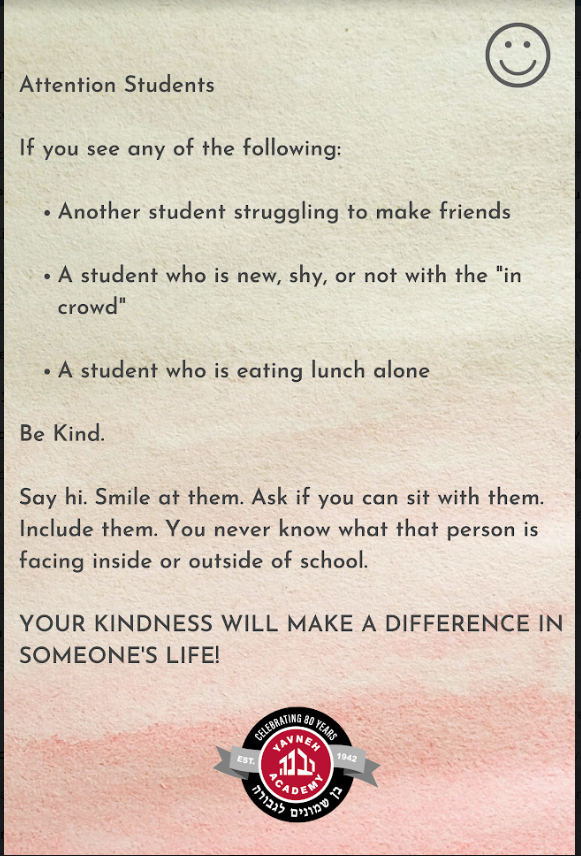
In this vein, this past Friday at the Middle School oneg we introduced a challenge to all of our students to be  more inclusive , expressed in this poster which will be hanging in the lunchroom, near the gyms and near the outdoors: 

Please do speak to your children about this campaign. 

Similar to what we said above, if we make an effort to have compassion and welcome in others, Hashem will have more compassion on us.  Let us make an effort in these Aseret Yimei Teshuva to stress to our children the midda of compassion for others… and may we merit to be showered upon by the compassion of the Almighty. 


Advisory Update:

Sixth Grade: Students identified strategies for success in middle school that they want to implement based on tips from last year’s sixth graders.


Seventh Grade:  Students had the opportunity to debrief and share how 7th grade is going for them so far in a “How Are We Doing” lesson.


Eighth Grade:  Students set S.M.A.R.T. goals for the year and recorded them in an e-mail that will automatically come into their inbox when they graduate to see if they achieved their goals.

Saturday, September 17, 2022

A Little Stress Is Good For You!

      I am part of a Prizmah group for school guidance staff and we recently discussed a book by Dr. Deborah Gilboa called From Stressed to Resilient.   She begins her book noting that much stress comes from change- even change that we have desired to happen. The ability to navigate the stress from change and come through despite faltering and struggling is resilience She ends her introduction with the realization that “well-being and success aren’t achieved through avoiding stress and running away from change.   Well being and success are achieved through using stress and navigating change.”   


She compares stress to exercise. For most, exercise is not fun and leaves us feeling exhausted and out of shape. But, we know that the more we exercise the more  our body learns how to manage the physical activity. The same with stress. At first we feel overwhelmed by stress.  But, the best way to learn to handle stress is by building your mental endurance by slowly experiencing stress. 


The truth is, our brains hate change. Our brains are wired to keep us alive and to do so to keep the status quo.  Gilboa adds that the brain sees any change as a risk and focuses on how uncomfortable it will be.  But, our job is to not let our brains fool us!  The first step when those negative thoughts come to the fore about how dangerous it is, thereby causing stress, is to think about the positives that change will bring.   (The rest of her book discusses the process of how to do so). 


This concept relates perfectly to two areas of our lives we are presently confronting.  First, the change of the new school year. Those of us who are parents of sixth graders are feeling it more acutely, as the transition to middle school can be quite stressful. (For both the children and the parents!)  And, while they are well-prepared, and we are slowly transitioning them, it is a HUGE change from what they are used to.  And, to some extent our 7th and 8th graders are going through change as well, albeit much smaller.  


And, I remind myself that dealing with small amounts of stress due to change is in their best interest.  So,  while I am tempted to want to ease all their stress, and if they are, for example, worried about the quiz, to simply cancel the quiz, I remind myself that eliminating stress is not the solution. We can cushion them and support them, but getting rid of all stress will not help them in the long run. 


As I have written many times in this column before, in her book, The Blessing Of A Skinned Knee, Dr. Wendy Mogel stresses the importance of allowing our children to struggle and fail.  If we overprotect them from feeling pain, they are also protected from growth.  If they are insulated they are incapable of dealing with any adversity and become “teacups” that “chip like a teacup” when confronting difficulty.  We do spend much time in our Advisory curriculum dealing with stress management and resilience in the face of difficulty. 


There are also three important benefits to the stress of change:

  1. Resilience- we discussed this above. We do cushion them to a certain extent, so these are really “mini-stressors” they are experiencing.  Dealing with these smaller stressors now helps them learn to cope with more difficult stressors in life and develop strategies for dealing with them.

  2. Motivation- a little bit of stress can be the fuel that drives students to achieve in school, persist through their work and even extra-curriculars. 

  3. Relationships- when students go through change and stressful circumstances together, it does create special bonds. 


(I do want to reiterate that both our teachers and the middle school administration are doing everything we can to ease the sixth graders’ transition. But  if you feel your child is facing an undue amount of  stress please feel free to reach out so we can put our heads together and uncover some solutions). 


The second area this concept brought to mind was the Teshuva season we are now in.  We are all undergoing the stress and fear of Divine judgment and the need for change. And, while we noted that change is good for us, it comes with stress.  This time of year can make us nervous and uncomfortable, as Chani Gotlieb notes in her article “My Fear of Fear.”  She too speaks about that she has often considered not focusing at all on the stressful, fearful component of the self-scrutiny, wrong-doings and guilt and instead focus on the “joy evoked by the coronation of Hashem on Rosh Hashanah and the happiness of achieving atonement on Yom Kippur”  as that is more pleasant for her.  


But, eliminating stress and fear is not good for us. In fact, we actually request fear at this time of year in the tefillah of Yamim Noraim:  וּבְכֵן  תֵּן פַּחְדְּךָ ה’ אֱלֹקינוּ עַל כָּל מַעֲשֶֽׂיךָ

And so place Your fear Hashem our God on all Your creations. 

Fear and the uncomfortable feelings of stress are integral features of this time period. 


She continues to quote a section from Rav Soloveitchik’s Al HaTeshuva- On Repentance, page 223,  in which a psychiatrist comes to the Rav and maintains that we should take that line out of the davening as fear, anxiety, stress are all causes of mental illness and we should not daven for them.  The Rav responds: 


“Everyone seems to be beset with fears of all kinds. Some are afraid that they won’t be able to succeed in their careers, others fear losing their wealth or status or that they will fail to attain sufficient prominence. Many people are afraid of sickness and bodily weakness. In generations past, fear of leprosy engulfed the world; today people live in fear of a cancerous growth. Many people don’t go to see a doctor even when they have pains, lest he diagnose them with the dreaded disease.

I’m not a psychiatrist, but I do know that one major source of fear can wipe out all of these lesser fears. What fear can overtake man, thereby uprooting all other fears, such as that of failure, of poverty, of old age, of rejection or of disease? Only the fear of the L-rd! That’s the reason behind the expression in the High Holy Day prayer, “Cast [Your] fear, O L-rd our G-d, upon all [Your] handiwork and [Your] awe upon all that [You have] created.” We pray that this great fear will free us from those other ones which lurk everywhere, upsetting our lives``


Gotlieb reiterates what Gilboa states that we need fear to keep us from harm and we are therefore hard-wired to experience fear.  It is part of our survival instinct in order to avoid things that are actually dangerous for us.  The Rav is noting that if we have “fear” of Hashem it is really “awe”of Hashem and it means that no matter what we are afraid of in our day to day lives, Hashem is coordinating all on high.  If one fears Hashem one need not be afraid. As Hashem says to Avraham in Bereishit 15:1: 

אַל־תִּירָ֣א אַבְרָ֗ם אָנֹכִי֙ מָגֵ֣ן לָ֔ךְ

Do not be afraid, Avraham. I will protect you. 

(Rav Aharon Lichtenstein, in his article “Teshuva and Joy” notes that while the process of Teshuva may be stressful and fearful it is also full of joy. We are joyful that we are able to connect to Hashem in an intimate way and redress our wrongdoings as He will accept our Teshuva). 


While stress and fear in small amounts may be unpleasant, they are good for us.  As we began Selichot last night and we begin the school year, may we take advantage of the small amounts of stress, change and fear that this season conjures up  to become more resilient and achieve the self- improvement that change can bring about. 


Advisory Update:

Sixth Grade: Students engaged in learning the skills of having a good give and take discussion in Advisory.


Seventh Grade; Students discussed what it takes to make an impact. 


Eighth Grade:  Students discussed setting S.M.A.R.T. goals for the year and the importance of grit.

Sunday, September 11, 2022

Focus As Individuals And As A Community

         I was reading a Jewish magazine over Shabbat and came across an ad for something called Project Focus which stated  “Prepare for the Yamim Noraim with focus.” It then continued with the words from Tehillim 121-  אשא עיני  I lift up my eyes.  And, the ad then stated underneath  “Look up.”  


I was thinking the Project Focus must be about a spiritual endeavor to make the Teshuva process more impactful during Elul and as we approach Rosh Hashana. But, when I went on the website of Project Focus after Shabbat,  I realized that “Look up” meant “Look up from your phone when speaking to your family.” Project Focus was about finding more focus in the world of technology. I found a series of tips on this Jewish website- here are some below. 


Whether or not you agree with these few tips of “focus” it struck me that Elul and the Yamim Noraim are about self-improvement.  This area of being distracted by technology is clearly an area I can say I need to work on. 


 (Please note that focus is needed for the process of Teshuva in general. As I found in the Teshuva Packet  of Rabbi Asher Baruch Wegbreit, one reason we do not do Teshuva is: 

We don’t have time to do Teshuva: Although the Ramban advocates spending every day of one's life working on Teshuva (Igeres HaRamban), we certainly find it difficult to do during the rest of the year. Yet even now in Elul, with the Shofar blasting every day to remind us to do Teshuva and even right up to Rosh HaShana and Yom Kippur, we still find it hard to "squeeze in" the time for working on Teshuva. What to do about it: Take a moment to identify even a five minute period of the day where you can sit even semi-quietly and focus on Teshuva. How about placing it into your Shemone Esrei (in the right place)? That's a time you're already committed to three times a day. “ )


I am sure you have all been following the joint efforts of the RCBC and local middle and high schools who have partnered together for an initiative called “Living Connected” to consider the impact technology has on our lives. This endeavor was launched last week in the Jewish Link.  I am proud to be a part of this effort.  We actually began a prelude to this initiative about three years ago when the schools banded together to create inter-school programming on the impact (both positive and negative) of technology.  That programming was interrupted by covid, and we are already meeting together as schools to plan our first inter-school event coming soon.  (Stay tuned!) 


As part of this “Living Connected” community project a few of us who are guidance staff in schools were asked to respond to a question posed.  Here is what my response was in the Jewish Link this week. 


 "As a parent I often have mixed feelings about my child's social media use. On one hand, it is wonderful to see her engaging with her friends and posting photos of her accomplishments. But, coming from a generation where we didn't do that growing up - I  have a hard time getting used to her constant posting and checking her friends' posts. Also, I have a hard time wondering if this will affect her sense of self.  Am I just old-fashioned?" 


Dear Parent, 

I too struggle each day as an “old-fashioned, ” less than tech savvy adult- and I spend my day with teenagers!   Working in schools for 27 years, and recalling when our students first got e-mail, I do see many of the positive results of the technology in which our children are engaged.  Relocating to a new town is not as traumatic as it used to be, as students are able to connect with friends in a way they never were able to in the past.  A child who is a bit shy, who years ago would feel isolated, feels comfortable fostering friendships online.  Teens are able to advocate for Israel, stand up for the environment or become upstanders against bullying- feeling powerful and as if they can literally change the world-  all thanks to social media.  Social media has boosted the self- esteem of numerous students and has helped them find their inner strengths. 


But, I must share that I, ironically, see the opposite as well.   In our Body Image curriculum I often utilize the  excellent curriculum and videos of the Dove Self-Esteem project (yes, created by the makers of Dove soap).    In their article “The Impact of Social Media on Body Image”  they highlight that in today’s world young people are “living their lives in full view of an online audience.”   Selfies, likes, and comments on their posts help them feel accomplished and accepted.  But, this has led to teens CONSTANTLY seeking the validation of others. Likewise, comparisons with the photos of others cause teens to be dissatisfied with themselves or what they are accomplishing. When they look at the posts of others it always looks as if “Everyone looks like they’re having the best day ever, all the time...unlike me.  Why is their life so much better?” Researchers at Stanford University call these feelings the “duck syndrome”- as ducks always appear to be gliding without effort across the pond, but are frantically paddling below the surface to stay afloat. 


Researchers at Facebook themselves noted in March 2020 that 

“Thirty-two percent of teen girls said that when they felt bad about their bodies, Instagram made them feel worse.  Comparisons on Instagram can change how young women view and describe themselves...Teens blame Instagram for increases in the rate of anxiety and depression. This reaction was unprompted and consistent across all groups. (Boys and girls). Teens blame Instagram for increases in the rate of anxiety and depression. This reaction was unprompted and consistent across all groups.”

It makes sense that all of this begins in the middle school years, as teens start to leave behind the cocoon of family and begin to judge themselves based on the standards of society. Psychologist Erik Erikson calls this stage of life the Identity Versus Confusion phase, when children struggle to understand how their emerging selves might fit into the larger picture. In the “olden days” teens would ask their friends directly to find that identity. Now they have social media. 

How can we as parents help?  This issue is no different from any other issue our teens are facing- we as parents need to TALK ABOUT IT with them. We need to have conversations with them about “How does it feel when someone likes your post?  Do you ever compare yourself to someone else? Do you ever feel worse about yourself after being on social media? Do you really think the other person’s life is as ‘perfect’ as it seems?”  When it comes to body image specifically, speak to them directly about the skewed images they often see on social media.  

And, if you feel “uneducated” about social media and therefore unable to discuss, do get educated!  But, in the meanwhile, as Janell Burley Hoffman, author of iRules  says, Let your child be the teacher. Ask questions! They are eager to teach us about their online worlds and while they are teaching we can bring in a larger conversation. 

Instagram has also indicated very directly in their research that teens do feel addicted to social media and lack the self- control to limit the amount of time spent on social media.  So, another way we can help is to every so often have  our family take a Tech Shabbat- and not on Shabbos!  Let’s all take a break from technology in general or social media in particular.  


I recently came across the words of the Lubavitcher Rebbe from 1966 regarding technology: (He was focusing on the radio!) 


Our sages have said: ‘All that G‑d created was created for His honor.’ This also applies to all the scientific discoveries of recent years—their purpose is to add honor to G‑d by using them for holiness, Torah, and mitzvot . . .There is a special advantage in using radio to teach Torah. Even if a person is not sufficiently motivated to go and attend a class, or even if he turned on the radio only to hear something else, the words of Torah reach him.

So too, social media has so many positive uses. Mishlei 18:21 states: מָ֣וֶת וְ֭חַיִּים בְּיַד־לָשׁ֑וֹן Life and death are in the hands of the tongue.  Today’s “tongue” is social media- it is the way we communicate and pass on information about ourselves and others. It can be for -   חיים -inspiring personal growth- or for מות - it can be harmful to one’s self-esteem. 

May we as parents and educators help our children tap into the חיים that social media has to offer. 

We do know how  much technology adds to our lives. But, we also know how much it can detract.  Just like with Teshuva in general, as Project Focus notes on their website: We know it’s not that easy to change tech habits. That’s why we’ve got dozens of small changes that can help create long-lasting habits. That is what change is about- small, progressive change- often called mini-habits,  microhabits or micromoments. We need to set small doable goals that are achievable and focus on what needs to change. 


Advisory Update:   

Sixth Grade: Half of our sixth graders had their first Advisory session where they got to learn what Advisory is about, how to have a give and take conversation and got to know each other better. 

Seventh Grade: Students were introduced to the 7th grade Advisory theme “Prepare Yourself to Change the World.”

Eighth Grade:   Students were introduced to the 8th grade Advisory theme  “Preparing for Life After Yavneh” and did some ice breaker activities.